3 Proven Ways to Master How to Store a Dinghy on a Sailboat Safely
How to Store a Dinghy on a Sailboat: Towing, Davits and Deck Storage
First of all, what is a dinghy and why is it essential for your sailing holiday?
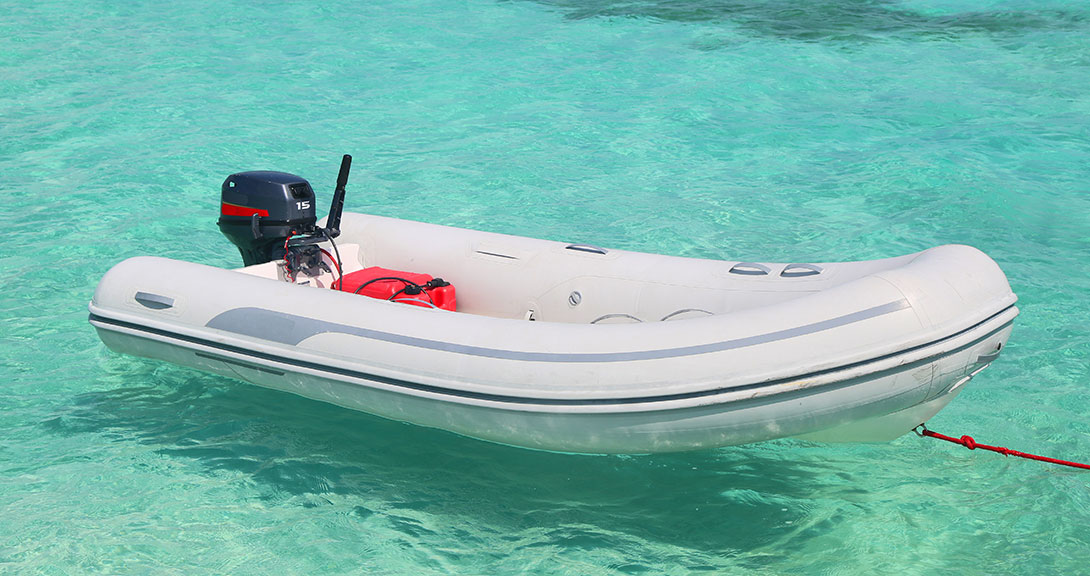
The Dinghy is a small rowboat or an inflatable rubber life raft that, in most cases, is an essential part of your obligatory equipment on your chartered yacht. Usually, it comes with an outboard engine, depending on the size of your chartered yacht. It is essential because, for example, your sailing yacht's deep keel prevents you from reaching places like shallow bays with beautiful beaches; therefore, having a dinghy is an essential accessory that extends your yacht's capabilities.
A Dinghy, sometimes called a tender, is one of the most valuable pieces of equipment you have on a sailing holiday.
You'll use your tender a lot while sailing. If you're going to be making several shore excursions in the bays, you'll need a sturdy and reliable dinghy.
To get the most out of it, you need to think carefully about storing the Dinghy on a sailboat. The way you tow it or stow it affects safety, comfort, boat handling and even your sleep at night. In this guide, you will learn how to store a dinghy on a sailboat, how to choose the right Dinghy for sailboat cruising and how to compare the three main options for tender storage on a boat: towing, davits and deck storage.
3 Main Ways to Store a Dinghy on a Sailboat
There are three common ways to carry and store a dinghy on a sailboat:
- Towing it behind the yacht
- Hanging it in davits off the stern
- Stowing it on deck
Each method has advantages and disadvantages. In many charters you will actually use more than one method, for example towing in calm bays and hoisting on deck before a longer or rougher leg.
Comparison Table on - Best ways storing dinghy on sailboat
Towing the Dinghy Behind the Sailboat
Towing is the easiest choice. The Dinghy follows you, already in the water and ready to use when you arrive. For short passages between bays in light to moderate conditions, this works very well.

Pros of Towing
- No heavy lifting or complex rigging
- The Dinghy is always ready for immediate use
- The outboard can stay on the Dinghy in calm weather and short distances
Cons and Risks of Towing
- Slows the yacht as you drag it through the water
- At night, when the wind drops, the Dinghy can swing and tap against your hull
- The tow line can foul the propeller if it is too long or if you reverse carelessly
- Not safe in strong winds, rough seas or longer offshore legs
You can reduce annoying tapping noises by putting fenders between the Dinghy and the hull and by adjusting line length.
How to Tow a Dinghy Safely
- Choose the tow line: Use a strong floating line of suitable diameter and avoid very long lines that can sag into the propeller
- Attach the line: Ideally, use a bridle that splits to two firm aft cleats for stability. Secure knots and check for chafe points
- Remove or secure the outboard: For short, calm runs, you can leave it mounted and tilt it up and for longer or rougher runs, remove them and store them on the stern rail or bracket.
- Adjust the distance behind the yacht: In calm weather, keep the Dinghy far enough back to sit in smooth water. In busier or choppy conditions, keep the Dinghy closer but clear of the wake.
- Check during the passage: Regularly look back for water in the Dinghy, line chafe or contact with the hull. If conditions worsen, recover the Dinghy into davits or onto the deck
Avoid towing the Dinghy at night in busy areas or in any forecast that suggests strong winds or bigger seas.
Storing the Dinghy on Stern Davits
Davits are metal structures mounted at the stern that allow you to hoist the Dinghy out of the water and suspend it behind the yacht.
Dinghy Hanging off the stern.
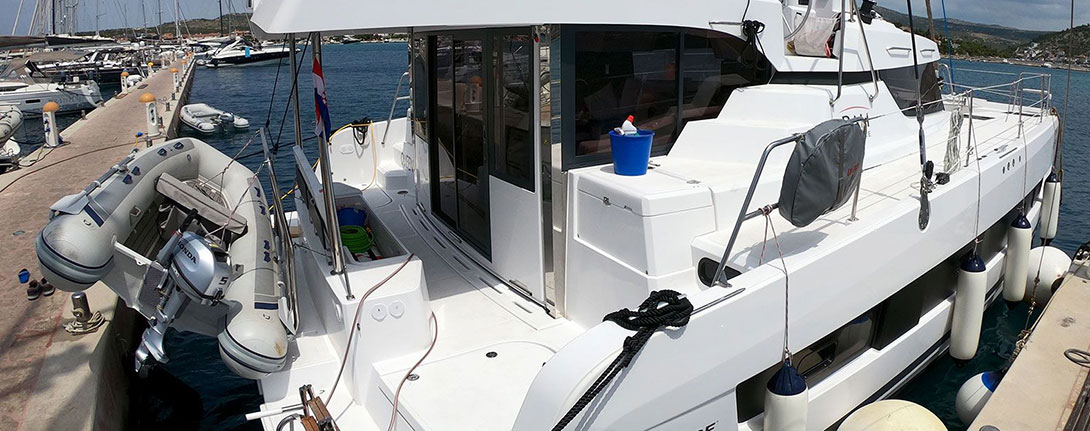
Keeping the Dinghy in davits off the stern is one step up from towing your Dinghy because it gets it out of the water, which means you won't have to drag it along. Davits are permanently installed and ready to accept your Dinghy. All you need to do is connect the ropes and crank it out of the water. The problem with davits is it keeps your Dinghy right side up and hanging off the back of your stern. Should you find yourself in the rough sea conditions, a boarding wave could crash into the Dinghy and fill it with water. The surge of weight would rip your davits right off and potentially cause damage to your hull as the davits yield under the weight. If the davits don't break, your stern will now be severely weighted by all that added water, and this will cause it to squat lower, posing more risk.
Pros of Davit Storage
- Dinghy is out of the water, less drag and less fouling
- Quick and easy to launch, helpful on a busy charter holiday
- The outboard often stays on the Dinghy
Cons and Risks of Davit Storage
- In rough conditions, a boarding wave can hit the Dinghy from astern
- If the Dinghy fills with water, the sudden weight can stress or damage the davits and even the hull fittings
- Extra weight at the stern can make the yacht squat and change handling
- Not always available on bareboat charter yachts
How to Use Davits Safely
- Check davit ratings and hardware: Make sure the davits and fittings are suitable for the weight of the Dinghy plus the outboard and inspect shackles, blocks and lines for wear.
- Prepare the Dinghy: Remove heavy gear that you do not need to lift and secure the fuel tank, oars and any loose items.
- Attach lifting lines: Use the proper lifting points on the Dinghy, usually designed for davit use. Make sure both sides are balanced to avoid twisting
- Hoist the Dinghy: Use the davit lines to lift evenly until the Dinghy is clear of the water and adjust its position so it sits securely behind the stern
- Secure for sea: Lash the Dinghy so it cannot swing side to side. In rougher seas, consider covering it and removing or tilting the outboard
- Monitor conditions: If heavy following seas or large waves are expected, consider moving the Dinghy onto the deck instead
Stowing the Dinghy on Deck
The last option is to stow the Dinghy on the deck. Here, it is out of the water and can be stored upside down, making it less of an issue with boarding waves. On-deck storage may sound like a great idea, but it presents a significant setback: loading and unloading.
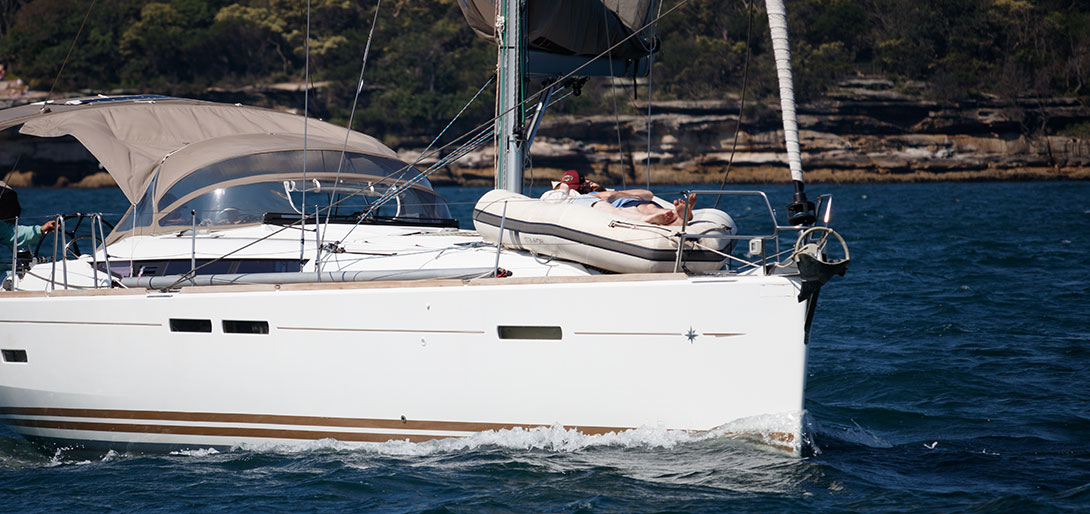
While it may seem impossible to get a heavy dinghy on the deck by hand, it is pretty doable with your rigging. Attaching a halyard to the Dinghy will allow you to lift its weight using a winch. Now you can carefully hoist and position the Dinghy on your deck without breaking your back!
This might seem like the easiest and safest way to store your Dinghy, but it does take some time to set up the rigging and carry out the launching and recovery of the Dinghy. Stowing the Dinghy on deck is often the most secure option, especially for longer passages or when rougher weather is possible. It is out of the water, often turned upside down, so it is less likely to fill with water from boarding waves.
The trade-off is effort. You need to hoist the Dinghy up and carefully position it so it does not block movement or hatches.
Pros of Deck Storage
- Safest option in heavy weather or offshore legs
- The Dinghy is protected from direct wave impact
- Less drag, no risk of tow line in propeller
- Often, it is more secure against theft when well lashed
Cons of Deck Storage
- More time and effort to hoist and secure
- Takes up deck space and can restrict movement
- Requires careful planning to avoid blocking sails, lines or hatch access
All three places have pros and cons, depending on what you are willing to deal with. Where you keep your Dinghy is a personal choice as to what kind of Dinghy you choose to carry.
Safety Tips When Using and Storing Your Dinghy
Your Dinghy is also an important safety tool. Whether you are towing it, storing it on davits or hoisting it on deck, keep these tips in mind:
- Wear a kill cord at all times: If you are driving the Dinghy with an outboard, the kill cord must be attached to the driver so the engine stops if the driver falls out.
- Use lifejackets: Everyone in the Dinghy should wear a suitable lifejacket, especially at night or in choppy seas.
- Keep clear of the docks in a swell: When there is a swell, keep the Dinghy away from the pontoon or rocky shore using a small anchor or a bow line. This avoids damage and injuries from sudden surges.
- Bring waterproof bags: Passengers should have waterproof bags for phones, documents and personal items that must not get wet.
- Never overload the Dinghy: Do not put too many people in the Dinghy. If needed, make two trips. Overloading makes the Dinghy unstable and dangerous, especially during boarding.
- Do not leave at night without a light: Always carry a flashlight or headlamp. A headlamp on the driver works very well, and a white light makes you more visible to other boats.
- Think about reboarding from the water: For swimmers, agree on how to get back into the Dinghy. Some people can manage a "sea lion flop" over the tube; others need a simple rope ladder or grab handle.
- Use the Dinghy for water sports rescue support: When people are stand-up paddling, windsurfing, kitesurfing or swimming far from the yacht, the Dinghy is your safety net, so in case the equipment fails or the wind drops, you can pick them up quickly. The Dinghy can also act as a barrier between swimmers and fast-moving jet skis or speedboats.
Dinghy Use and Mooring Buoys on a Yacht Charter in Croatia

In many Croatian bays, you will pick up a mooring buoy instead of anchoring. Here, the Dinghy is essential.
- If the buoy does not have a pickup line, you may lasso it from the yacht.
- On yachts with a high bow, it can be easier and safer to take the Dinghy forward, pick up the buoy from dinghy level and then pass lines back to the yacht.
- Once moored, you will use the Dinghy for all trips to shore, restaurants and beaches.
Your storage choice affects how easy this daily routine feels:
- Towing the Dinghy between nearby bays keeps it ready for the next buoy or anchorage.
- Davits let you hoist it in seconds when leaving a crowded mooring field.
- Deck storage is best when you are making a longer relocation sail along the coast or across open water.
By choosing the right Dinghy for sailboat cruising, and by understanding how to store a dinghy on a sailboat using towing, davits or deck storage, you make your sailing holiday safer, more comfortable and more enjoyable. With a bit of planning, your tender becomes a reliable extension of your yacht rather than a constant worry behind it.
FAQ: Dinghy and Tender Storage on Boats
Generally, it is not recommended to tow a dinghy at night, especially in busy or narrow waters. It is harder for other boats to see, and there is a higher risk of collision or line fouling. If you must tow at night, use lights, keep the dinghy close and reduce speed.