How to release a Stuck Anchor ?
How to Get an Anchor Unstuck on Your Sailing Holiday in Croatia?
Sooner or later, every skipper lives through the exact moment. The bay is calm, the crew is happy, the coffee is ready, and it is time to leave. You start to raise the anchor, the windlass works, the chain tightens, and then everything stops. The anchor is stuck on the bottom, and the boat is not moving.
If this happens to you in Croatia, do not panic and do not reach for the knife straight away. A stuck anchor is annoying, but it is usually manageable if you stay calm and work methodically. The most important thing to remember is simple. The solution is rarely brute force. Using brute force will lead to contradictory outcomes.
In most cases, freeing an anchor comes down to finding the right angle and applying steady, controlled pressure.
This guide explains how to get an anchor unstuck safely using your boat, what to do if the line breaks or you lose it, and how to reduce the chances of another stuck anchor for the rest of your sailing holiday. All examples refer to Croatian waters and typical Adriatic conditions, so that you can apply this advice directly during your charter.
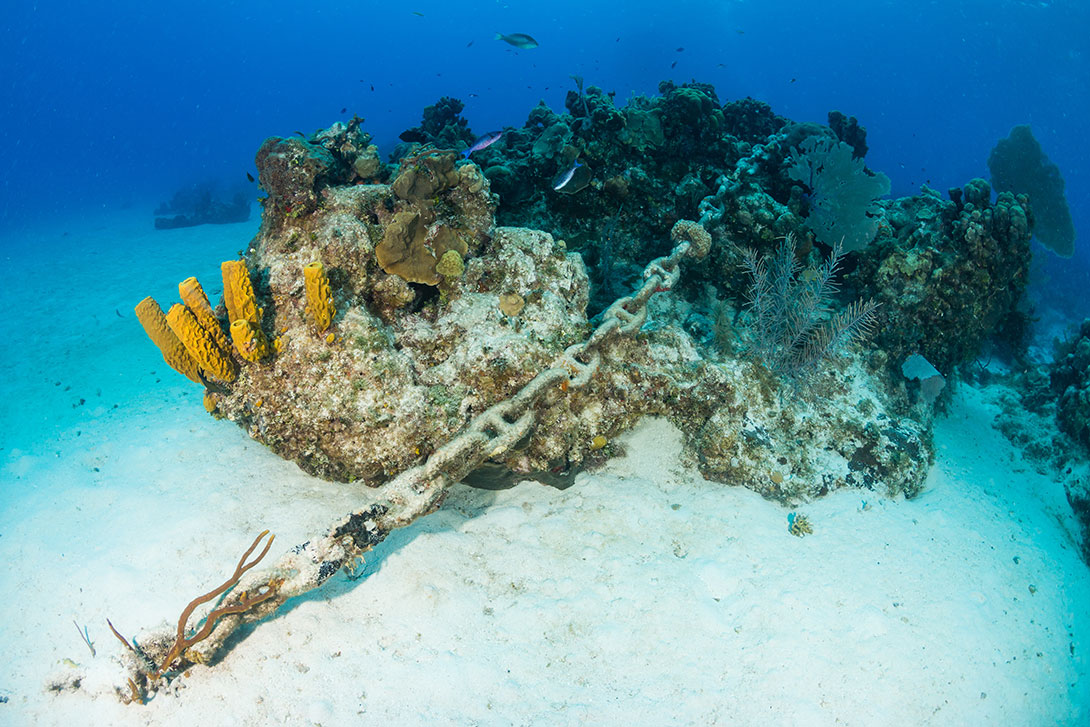
First Things First: When Your Anchor Is Stuck
Before you start pulling harder, take a moment to ensure your safety. A stuck anchor can become a safety concern if you focus solely on the chain and ignore your surroundings, so stay alert and cautious. Ask yourself three quick questions:
- Is my boat clear of rocks, shoals, and other ships if I swing or move forward?
- What are the wind and current doing right now, and could they increase suddenly?
- Is there enough depth and space around me to manoeuvre without risk?
If the answer feels uncertain, or if you already feel close to danger, do not experiment with complicated manoeuvres. Start the engine if it is not already running, keep the rode on a bow cleat, and be ready to call the local harbour office, marina, or your charter base for help. If you have enough space, the sea is not rough, and the crew is calm, you can start working on freeing the anchor.
Why Anchors Get Stuck in Croatian Waters?
The Adriatic's seabed can be tricky, but knowing why anchors get stuck helps you feel more in control and better prepared to handle the situation. Here are the most common reasons in Croatia:
Rocky seabeds and boulders
In many bays, the anchor digs between rocks or hooks under a ledge. When you pull in the same direction you set it, the flukes can bite deeper and lock in place.
Old chains, moorings, and debris
Busy anchorages sometimes hide old anchor chains, mooring blocks, cables, or other objects. Anchors can easily snag or wrap around them.
Weed and Posidonia seagrass
In many parts of Croatia, Posidonia is protected, so using correct anchoring techniques and environmental awareness can help you avoid tangled anchors and future issues, making your sailing safer and more enjoyable.
Incorrect scope or changing directions
If wind and current shift and the boat swings around the anchor, the rode can wrap around rocks, or the anchor can wedge itself into a new position.
A quick check of your depth sounder and charts before you drop the anchor, and a bit of patience while setting it, can prevent many future problems.
Overview: 3 Reliable Ways to Free a Stuck Anchor
Most skippers use three primary methods to free an anchor that is stuck on the seabed:
- Use the boat's natural movement to lift it vertically
- Change the direction of pull by motoring forward gently
- Use an anchor retrieval ring and buoy if you have the right equipment
Before you start, it helps to keep one safety point in mind. Avoid loading the anchor rode too heavily. If the line or chain is under extreme tension, it can release suddenly. That snapback can injure crew and damage cleats, windlasses, and deck fittings.
3 Reliable Ways to Free a Stuck Anchor
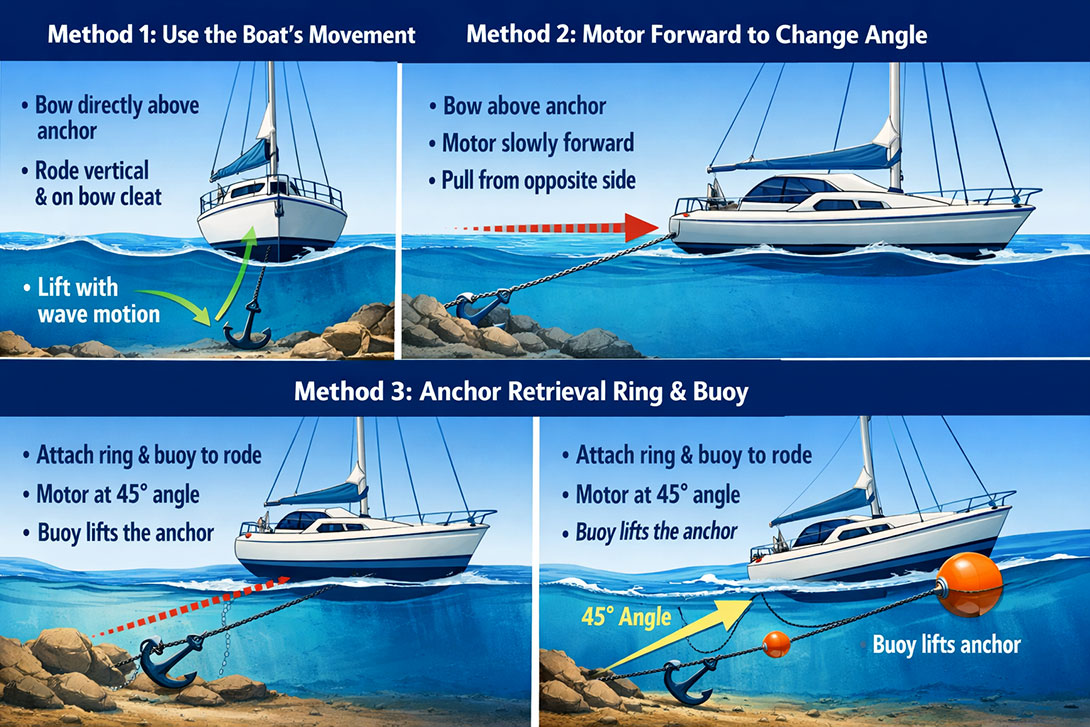
Method 1: Use the Boat's Natural Movement (Vertical Lift)
This is often the safest and most straightforward method. You use the boat's movement to create a gentle vertical pull that can lift the anchor out of the seabed.
Steps:
1) Bring the bow over the anchor - Start the engine if it is not already running. While one person operates the windlass or pulls in line, the skipper manoeuvres so the bow is directly above the anchor. Take in the chain or rope until the boat feels like it is sitting right over it.
2) Secure the rode on a bow cleat - Take one turn of the line or chain snubber around a strong bow cleat. Do not fully tie it off. Keep control of the tail so you can ease it quickly if needed.
3) Use the wave motion - Watch how the boat moves. As the bow drops into a trough, take in slack to keep the rode tight. When the bow rises on the next wave, that vertical force often pops the anchor free.
4) Protect your hands and the boat - Keep fingers clear of the cleat and the rode. When the anchor releases, the line can jump suddenly. Recover it steadily and stay alert.
Many stuck anchors come free after one or two gentle lifts. If several tries do not work and the load keeps increasing, switch to the following method rather than pulling harder and harder.
Method 2: Motor Gently Into Wind or Current (Pull From the Opposite Direction)
If the anchor does not release with wave motion, you can try changing the direction of pull. An anchor that is jammed from one side will often come out if you pull it from the opposite direction. This method is also one of the best options when the anchor is hooked under a rock ledge. This technique requires enough space ahead of the boat, since you will be motoring slowly forward.
Steps:
1) Position the boat directly above the anchor - Bring the bow over the anchor again, keeping the rode vertical and tight.
2) Keep the rode secured to a strong bow cleat - The anchor line or snubber should stay on a bow cleat. Do not move it to the stern. Pulling from the stern can make a small boat dig its transom into waves, which is dangerous.
3) Motor slowly into the wind or current - With the line tight, gently move the motor forward. Use low revs and build power gradually while watching how the bow behaves.
4) Feel for the anchor breaking free - You should feel steady resistance at first. If the anchor starts moving, the load often reduces suddenly. At that moment, ease off the throttle and take in the rode so the anchor does not dig in again.
5) Know when to stop - If the bow is pulled down hard, the cleat or fairlead is groaning, or the boat feels uncomfortable, you are using too much force. Ease off immediately. At that point, it is better to stop than to break something or risk injury.
Method 3: Anchor Retrieval Ring and Buoy (Advanced)
Some skippers carry an anchor retrieval ring with a buoy. This system slides down the rode and uses buoyancy plus the boat's pull to lift the anchor. When used correctly, it can be highly effective. This is an advanced method and works best in calm seas and open water. If the anchorage is crowded, the weather is rough, or you are unsure how the equipment works, it is usually better not to experiment. Ask for help instead. Basic use of a retrieval ring and buoy:
1) Attach the ring and buoy to the rode - Clip or thread the ring over the anchor rode at the bow, with the buoy attached. Make sure the rod can slide freely through the ring.
2) Motor forward at a gentle angle - Motor ahead slowly at about a 45-degree angle relative to the original anchor direction. As the boat moves, the ring and buoy will travel down the rope toward the seabed.
3) Let the buoy do the lifting - Once the ring reaches the anchor, the combined pull and buoyancy can lift the anchor off the bottom. The anchor then travels up the rode and often surfaces next to the buoy.
4) Watch the loads closely - If the rode becomes extremely tight, the bow is being pulled down, or the boat slows sharply, reduce power immediately.
5) Recover the anchor - Once you see the buoy behind you with the anchor at the surface, stop the boat, idle gently, and pull the anchor aboard from the buoy.
If the anchor still refuses to move, stop and ask for help. A stuck anchor is not worth damaging equipment or risking the crew.
When the Anchor Still Will Not Come Free:
Sometimes, even after trying all three methods, the anchor refuses to move. At that point, you have three realistic options: inspect it underwater, return later, or abandon it. Checking the anchor underwater If the water is shallow, clear, and calm, and you are a confident swimmer, you might look at the anchor with a mask and snorkel.
Never do this alone. Never do it in a strong current. Never do it near traffic. Never do it while the boat is moving. If you can see exactly how the anchor is stuck, you may be able to guide the skipper into a better angle from the surface. Sometimes, a small reposition underwater is enough. If visibility is poor, the water is cold, or conditions feel unsafe, skip this option and stay with surface methods only. Leaving the line and returning later.
In some situations, it makes sense to leave the anchor and return when conditions are better temporarily. Attach a buoy to the end of the rope, disconnect it from the boat, mark the position, and return later. Make sure the buoy is clearly visible and that the loose line is not near ferry routes, channels, or swimming areas where it could become a hazard.
When you must abandon the anchor?
Sometimes it is safer to let go of the anchor than to keep pulling. This can be the case if:
- The weather is deteriorating quickly
- You are drifting toward rocks or shallow water
- The loads on cleats and deck gear are clearly too high
If you have no other safe option, cut the line so that no loose rope remains near the surface. An abandoned anchor is unfortunate, but a damaged boat or injured crew is far worse. Afterwards, notify your charter base and follow their instructions. In some cases, the local harbour authority may also need to be informed.
What If You Lose the Anchor Line?
Sometimes the problem is not a stuck anchor, but a separated anchor line or chain. A shackle pin may not have been secured properly, a rope may have chafed through, or a cleat may have failed under load. Immediate steps:
- Start the engine and make sure the boat is entirely under control
- Check your position, depth, and nearby hazards
- If you attached a buoy to the anchor line, look for it visually and on the plotter
- If the water is too deep, too cold, or there is heavy traffic and current, recovery may not be worth the risk. Treat it as lost equipment, inform your charter company, and follow their guidance.
How to Avoid a Stuck Anchor in Croatia Next Time
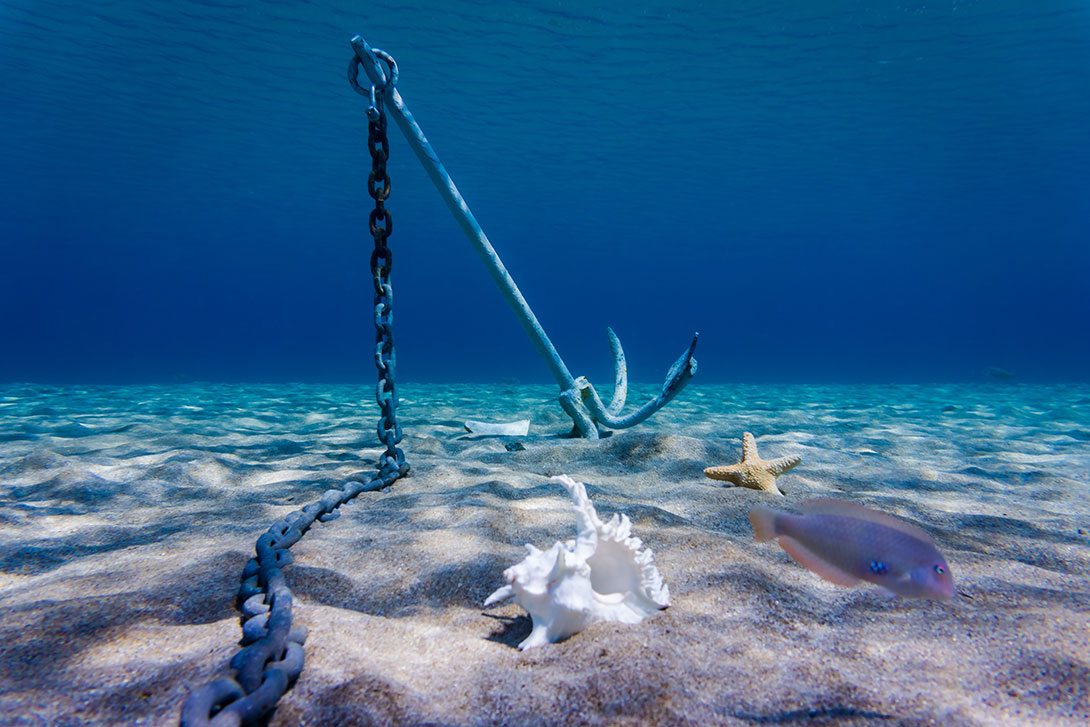
The best solution is to prevent the problem in the first place. A little preparation when you arrive in a bay can save a lot of effort later.
A simple anchoring routine for Croatian bays:
- Choose the right spot. Look for sand patches rather than rock or heavy weed. In many bays, you can clearly see the colour difference from the deck. Sand usually looks lighter and more uniform. Avoid clearly marked Posidonia meadows and no anchoring zones.
- Check depth and swing room. Confirm you have enough depth for your keel at low water and enough space to swing safely without hitting other boats, rocks, or fish farms. Use the proper scope.
- In calm conditions, around 4 to 5 times the depth is usually enough. In stronger winds, increase to 7 times or more. This helps the anchor set appropriately and reduces the risk of dragging into areas where it could become stuck. Set the anchor slowly and firmly. Lower the anchor to the bottom, then gently reverse to lay out the chain and set the flukes. Do not rush this step. A well-set anchor is less likely to wander into crevices later.
Environmental and Local Considerations in Croatian Waters
Croatia is working hard to protect its coast and seabed. As a visiting skipper, you share responsibility for keeping anchorages beautiful for the future. Keep in mind: Posidonia seagrass is protected in many areas. Anchoring in these meadows can damage them and may be restricted or forbidden. National parks and nature reserves such as Kornati and Mljet have specific anchoring zones and rules. Some areas have eco moorings that reduce seabed damage. Abandoned anchors and chains can become hazards for other boats, divers, and marine life. If you are forced to leave an anchor, report it to your charter base and provide the approximate position. For up-to-date rules, always check the latest information from the local harbour master, park authority, or your charter company before anchoring in a new area.

Frequently Asked Questions About Stuck Anchors
It can be safe if you do it slowly and carefully, with the rode secured to a strong bow cleat and plenty of space around you. You should never use high power, and you should stop immediately if loads become excessive.